
Click Here to Buy Discounted Unknown Cash (UC)
I. The Dual-Progression Landscape of PUBG Mobile
A. Introduction: Defining "Progression"
In the PUBG Mobile ecosystem, "Unknown Cash" (UC) is the premium, in-game currency purchased with real money. It allows players to acquire a vast array of in-game items, from cosmetic skins to seasonal passes. The utility of UC is directly tied to a player's goals, as "progression" in PUBG Mobile is not a single path but a bifurcated system. This report will analyze how UC impacts the two distinct, parallel progression tracks available to players: the skill-based "Competitive Climb" and the collection-based "Reward Cycle."
A core component of the game's monetization psychology is the deliberate conflation of these two tracks through a single abbreviation: "RP." This abbreviation is used interchangeably to refer to "Rank Points," the measure of skill for competitive tiers , and "Royale Pass Points," the metric for advancing through the seasonal reward system. This ambiguity is not a design flaw; it is a sophisticated psychological framework. By blurring the line between skill-based advancement and item-based collection, players who feel "stuck" in one system (e.g., unable to advance their competitive Rank) are subtly encouraged to spend UC to feel a tangible sense of advancement in the other (the Royale Pass). This report will disambiguate these two systems to provide a clear analysis of where UC provides tangible value and where its influence is non-existent.
B. Track 1: The Competitive Climb (Skill-Based Progression)
This progression track is a pure meritocracy, defined entirely by a player's in-game skill and performance. The competitive ranking system is a tiered ladder that players ascend by earning "Rank Points" (RP). These points are gained (or lost) based on a formula that weighs survival time, total kills, damage dealt, and final match placement.
The tiers, from lowest to highest, are:
-
Bronze
-
Silver
-
Gold
-
Platinum
-
Diamond
-
Crown
-
Ace
-
Conqueror
Each tier from Bronze to Crown is further divided into five sub-divisions (V to I). The "Conqueror" tier is the pinnacle of this system, reserved only for the top 500 players in any given region, making it the ultimate testament to a player's dedication and skill.
In relation to UC, the developer's official position is clear and consistent: purchased items provide "no direct competitive advantage". A player cannot spend UC to purchase "Rank Points" or to gain a higher competitive tier. Progression on this track is free and is achieved exclusively through practice, strategy, and successful gameplay.
C. Track 2: The Reward Cycle (Monetized Progression)
This second track is defined by collection and is the primary monetization engine of PUBG Mobile. The "Royale Pass" is described as the "main way for players to get rewards in the game". This system is a 100-level seasonal event where players complete "Daily Missions" and "Challenge Missions" to earn "Royale Pass Points" (the other "RP"). Each level unlocked grants a reward, ranging from in-game currency (like AG) to exclusive outfits, weapon skins, and emotes.
This track is where UC is the dominant force. While players can participate for free, their access to rewards is severely limited. UC is the key that unlocks the premium reward stream, provides access to more missions, and allows players to progress faster. It is a textbook example of a "pay-to-progress" system , and it is the most direct and impactful way a player can use UC to "progress quicker" within the game's reward framework.
II. UC as an Accelerator: Dominating the Royale Pass (The "Pay-to-Progress" System)
The most direct, undisputed, and valuable function of UC is to accelerate a player's progression through the seasonal Royale Pass. UC transforms this system from a slow, limited-reward grind into a high-value, high-velocity reward stream.
A. Unlocking the Premium Track: A Cost-Benefit Analysis
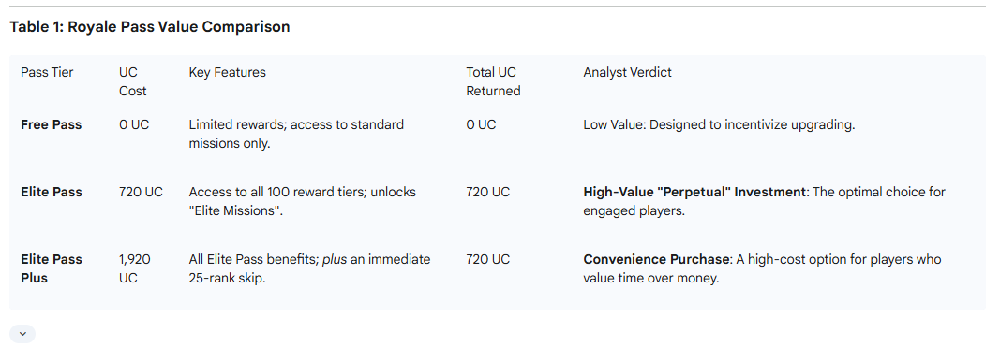
The Royale Pass system is tiered into three levels, each offering a vastly different value proposition. The decision of which, if any, to purchase is the single most important financial choice a player can make.
-
The Free Pass: This tier is open to all players at no cost. It provides access to standard daily and challenge missions and a small, curated set of rewards from the 100-level track. Community analysis suggests that the Royale Pass Points available to free players are insufficient to reach the highest levels (e.g., Level 100), making this track feel incomplete and unrewarding by design.
- The Elite Pass: This is the standard premium upgrade. It costs 720 UC for the full 1-100 level pass (older versions cost 600 UC ). Purchasing this pass immediately unlocks the premium reward track for all 100 levels, granting access to high-value cosmetics like mythic outfits and upgradable weapon skins. Crucially, it also unlocks "Elite Missions".
- The Elite Pass Plus: This is a high-cost convenience bundle. It costs 1,920 UC and includes everything in the Elite Pass, but also grants an immediate 25-rank skip. This bundle is a pure "pay-to-skip-the-grind" option, offering those 25 levels at a 40% discount compared to purchasing them individually.
B. Quantifying the Acceleration: How the Elite Pass Speeds Up Progression
The "quicker" progression of the Elite Pass is not just theoretical; it is a quantifiable mechanical advantage. The pass accelerates the acquisition of Royale Pass Points in two primary ways:
-
Elite Missions: Elite Pass holders gain access to an exclusive set of "Elite Missions". These missions, unavailable to free players, are designed to grant more Royale Pass Points than standard missions, allowing Elite players to level up at a significantly faster rate.
C. The "Perpetual Value" Loop: A One-Time Investment
This is the most critical financial insight for any PUBG Mobile player. The Elite Royale Pass is not a simple transaction; it is a brilliantly designed retention mechanic.
The 720 UC Elite Pass (levels 1-100) is structured to return the full 720 UC to the player as they progress through the 100 reward levels. A developer's choice to "break-even" and give back 100% of the premium currency spent is a strategic one. They are not selling a 720 UC pass; they are "buying" the player's engagement for an entire season.
By "investing" 720 UC, the player is now psychologically and monetarily committed to playing consistently to "earn back" their currency. This creates a powerful habit loop. A player who successfully grinds to Level 100 reclaims their UC and is perfectly positioned to buy the next season's pass, repeating the cycle. For any dedicated player, the Elite Royale Pass functions as a one-time purchase that pays for itself in perpetuity, allowing them to permanently access the fastest reward progression track. This is contingent, of course, on the player not spending the returned UC on any other in-game items.
D. Brute-Force Progression: Buying Ranks
For players with significant disposable income who value time above all, UC offers the ultimate "pay-to-progress" solution: buying ranks directly. The Elite Pass Plus bundle is the most "cost-effective" method, offering 25 ranks at a 40% discount. However, any player can use UC at any time to purchase individual levels, instantly advancing their pass. This is the purest form of progression acceleration, completely divorcing the reward stream from in-game playtime or mission completion.
III. The UC Marketplace: Assessing Crates, Spins, and the Weapon Lab (The "UC Sinks")
Beyond the high-value, predictable investment of the Royale Pass, the PUBG Mobile economy is dominated by "gambling" mechanics. These systems are "UC Sinks": high-cost, high-risk, low-probability expenditures designed to extract large amounts of UC from a small percentage of the player base in exchange for cosmetic prestige.
A. Crates (Premium & Classic)
Players can use UC to purchase keys to open Premium and Classic Crates. These crates contain a loot pool of random cosmetic items. The community consensus on crates is overwhelmingly negative. They are widely considered a "waste" of UC.
One user report details opening "$350" worth of "increased сhance" classic crates, only to receive three legendary items, concluding the price for an unwanted item was "too high". The common advice from veteran players is to "Never open classic creates" and "Don't waste Your UC's on Classic Crates," as it can cost "100s of dollars for methic skin".
B. Lucky Spins
"Lucky Spins" are time-limited events that use FOMO (Fear Of Missing Out) to drive high-volume spending on exclusive, themed item sets. These systems employ a classic "foot-in-the-door" psychological pricing tactic: the first spin of the day is heavily discounted to just 10 UC.
This low-cost entry is deceptive. A regular single spin on the "Lunar Castle" event costs 60 UC, with a 10-draw bundle costing 600 UC. Because the odds of receiving the top-tier items are extremely low, the cost to "complete the collection" is astronomical. It is estimated to cost most players between 48,000 and 50,000 UC to acquire all items from a single spin event, with worst-case scenarios exceeding 60,000 UC. These are "whale-only" mechanics.
C. Case Study: The Weapon Lab (The Ultimate "UC Sink")
The "Weapon Lab" is the apex of PUBG Mobile's prestige monetization, and a masterclass in psychological design. It is not a simple purchase but a two-stage UC sink that leverages the "sunk cost fallacy" to drive exponential spending.
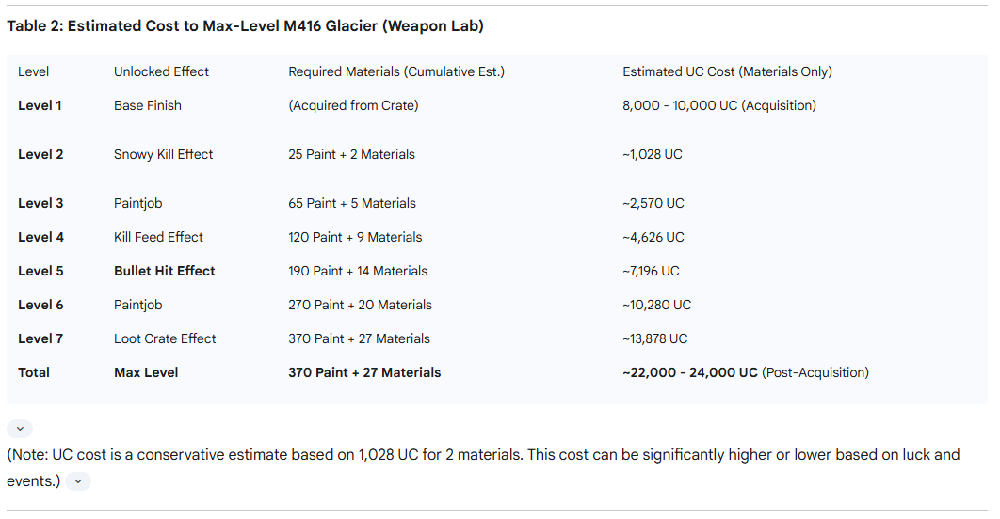
Stage 1: Acquisition. A player cannot simply buy an "Upgradable Weapon Skin" like the legendary M416 Glacier. They must first acquire the base-level skin from a low-probability crate or lucky spin. This step alone is a high-cost gamble, with players reporting it can take 7,500-10,000 UC just to get the base weapon.
Stage 2: Upgrading. After spending thousands of UC to "win" the base skin, the player is now psychologically "pot-committed." The base skin, however, lacks the most prestigious effects. The real goal is the "Bullet Hit Effect" (Level 5) or the "Loot Crate Effect" (Level 7). To unlock these, the player must now spend even more UC on "Materials" and "Paint".
This upgrade process is astronomically expensive. One user notes that two "Materials" can cost 1,028 UC. Players report that a single maxed-out, level 7 gun can cost "close to $1000 AUD each" , with some streamers and high-spenders reporting costs as high as "$10000 USD" for a single maxed weapon. The Weapon Lab is a system designed to monetize a player's own desire for completion, turning an initial "win" into a long-term, high-cost financial commitment.
IV. The "Pay-to-Win" Frontier: Does UC Buy a Competitive Advantage?
This report will now critically investigate the most contentious aspect of the UC economy. While the developer maintains that UC provides "no direct competitive advantage" , a significant body of community evidence suggests that PUBG Mobile operates in a "grey area," offering "soft" pay-to-win advantages that are packaged as cosmetics.
A. Defining the Terms: "Pay-to-Progress" vs. "Pay-to-Win"
To analyze this, we must use a clear framework.
-
Pay-to-Progress (P2P): This grants faster progression or access to items, but provides no unique advantage against a same-tier player. The Royale Pass (Section II) is a perfect P2P system.
- Pay-to-Win (P2W): This grants access to items, gear, or features that a free player "cannot be accessed at any point" and that provide a tangible competitive advantage.
PUBG Mobile's monetization strategy is to avoid hard statistical P2W. There are no UC-purchased guns that do +10% damage. Instead, the game implements perceptual or sensory advantages, which it can then defend as "purely cosmetic." This "plausible deniability" allows the company to claim "no direct advantage" , while players who are victims of these items experience them as a very indirect, but very real, pay-to-win mechanic.
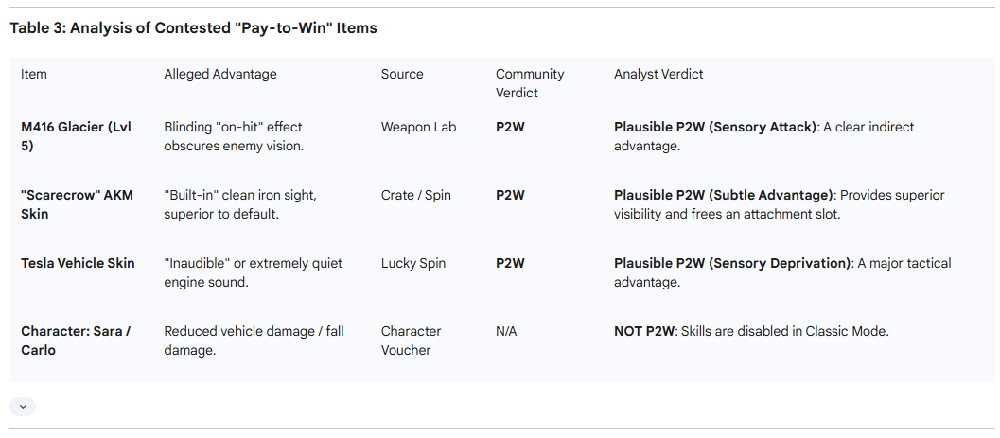
B. Case Study 1: The M416 Glacier's "On-Hit Effect" (Visual Obscuration)
-
The Item: The M416 Glacier, upgraded to Level 5 in the Weapon Lab.
C. Case Study 2: "Built-in Red Dot" Iron Sights (Visual Clarity)
-
The Item: Certain UC-acquired weapon skins, such as the "Scarecrow AKM".
-
The Cost: Acquired from various crates or spins.
-
The Alleged Advantage: The default iron sights on many PUBG Mobile weapons are notoriously "bad" and "difficult to work with". Some paid skins replace these obstructive sights with a clean, minimalist sight that is "basically a red dot". This provides "better visibility which is objectively an advantage". In a game where a Red Dot is a piece of loot that must be found, having a clean "built-in" sight not only provides an immediate advantage but also frees up an attachment slot.
-
Community Verdict: Pay-to-Win. This is a subtle, but clear, P2W advantage that improves a weapon's performance from the moment it is picked up.
D. Case Study 3: The Tesla Vehicle Skins (Audio Obscuration)
-
The Item: A high-cost, time-limited collaboration skin for in-game vehicles.
-
The Cost: Acquired through a high-cost "Lucky Spin."
-
The Alleged Advantage: The electric vehicle skin is "inaudible" or significantly quieter than the game's default vehicles
- Community Verdict: Pay-to-Win. This skin caused a major controversy. One player's post, "Has PubgM officially become P2W?", details being pushed by an enemy squad in a Tesla they "didn't hear a thing". In a battle royale where audio cues are critical for survival , this sensory deprivation provides a massive, undeniable tactical advantage by eliminating the sound of an approaching vehicle.
E. Debunking the Myth: Character Abilities
To provide a balanced report, it is essential to also debunk false P2W claims. Players can use UC or Character Vouchers to unlock special characters like Sara (reduces vehicle damage) or Carlo (reduces fall damage). While these are statistical advantages, they are not P2W for the main competitive game. The game's files are explicit: "character exclusive skills are only applied in certain modes" and "do not apply in Classic Mode".
V. Final Verdict and Strategic Recommendations
A. Final Answer to the Query
To the user query, "How can PUBG Mobile UC help you to progress quicker?" the definitive answer is: UC's function is bifurcated, and its value is entirely dependent on a player's goals.
-
For Reward Progression: UC is the only tool to "progress quicker" through the game's 100-level seasonal Royale Pass. It unlocks the premium Elite Pass, which provides more missions, better rewards, and faster advancement. This "pay-to-progress" system is the single most valuable and strategically sound use of UC in the game.
B. Strategic Recommendations Based on Player Archetype
-
Path 1: The "High-Value" Player (Recommended)
-
Action: Purchase the 720 UC "Elite Pass".
- Strategy: Play consistently and complete all missions to reach Level 100, reclaiming the full 720 UC. Do not spend this returned UC on crates or spins. Use that same 720 UC to purchase the next season's Elite Pass.
-
Outcome: For a one-time, fully refundable "investment," this player gains permanent access to the fastest reward progression track, achieving the best possible value.
-
-
Path 2: The "Free-to-Play" Player
-
Action: Spend 0 UC.
-
Strategy: Focus 100% on the Competitive Progression track. Accept that Reward Progression will be slow and the cosmetic collection will be minimal.
-
Outcome: This player can still achieve the game's highest honor (Conqueror) based on pure skill, proving the game's core competitive loop is not hard P2W.
-
-
Path 3: The "Whale" / Collector
-
Action: Purchase UC in bulk from official sources like Midasbuy or third-party top-up services.
- Strategy: Purchase the "Elite Pass Plus" for the instant 25-rank skip. Spend tens of thousands of UC on "Lucky Spins" and in the "Weapon Lab" to acquire and max-level prestige items.
-
Outcome: This player achieves the fastest possible reward progression and a collection of rare items, including the "soft" P2W advantages outlined in Section IV. This path provides cosmetic prestige but is astronomically expensive and offers a rapidly diminishing return on competitive advantage compared to raw skill.
-
C. Final Analyst Verdict
UC is a tool. Its ability to "help you progress" is a matter of strategic definition. This report recommends that all players treat PUBG Mobile's two progression tracks as two separate games.
-
Use skill and dedication to climb the free, merit-based Competitive track.
-
Use a single, smart 720 UC investment to perennially master the "pay-to-progress" Reward track.
Players should avoid the predatory, low-value, high-cost "UC Sinks" (Crates, Spins, and Labs) unless their goal is purely cosmetic prestige. In doing so, they must be aware that they are participating in—and funding—a "soft" pay-to-win system built on plausible deniability, where "cosmetic" effects can and do provide a tangible, if indirect, competitive advantage.
